
Chromium-6 Project: What Customers Should Know
What is Chromium-6?
Chromium-6, also known as hexavalent chromium or CR6, is a naturally occurring mineral found in rocks, soil, and groundwater, including groundwater in the Phelan and Pinon Hills area. In 2024, the State of California adopted a new drinking water standard limiting Chromium-6 to 10 parts per billion (ppb). Under the State's compliance schedule, the District must meet the new standard by October 1, 2027.
Under the State's compliance schedule, the District must meet the new standard by October 1, 2027.
Some District wells have historically contained Chromium-6 above the new California standard. The District has been actively planning and investing in mitigation for many years - well before the current regulation took effect - and has pursued a combination of well improvements, new groundwater sources, water-right acquisitions, monitoring, and infrastructure projects to achieve compliance while maintaining a reliable water supply for the community.
How Did We Get Here?
California first established a 10 ppb Chromium-6 drinking water standard in 2014. Between 2014 and 2016, five District wells were identified as exceeding that new standard. The District initially developed a large-scale blending project that would have required approximately 14 miles of pipeline, two new blending reservoirs and two blending stations, at an estimated cost of $17 million.
In 2017, the State's Chromium-6 standard was invalidated by a court over concerns regarding the State's economic feasibility analysis. Although the regulation was no longer in effect, PPHCSD continued evaluating ways to reduce Chromium-6 and protect the District's long-term water supply. Those efforts included purchasing additional water rights and using well-profiling and redevelopment techniques to isolate portions of wells with higher Chromium-6 concentrations. Those techniques successfully reduced Chromium-6 levels in several wells, although in some cases they also reduced the amount of water the wells could produce.
California adopted a new 10 ppb standard effective October 1, 2024. Rather than simply returning to the original $17 million blending project, the District evaluated alternative strategies designed to meet the new standard at a lower cost while also improving the reliability of the water system. The current strategy includes development of new wells.
How Much is the District Spending on Chromium-6?
Chromium-6 compliance is one of the largest water-quality investments the District has undertaken. The District has already invested $9.6 million in Chromium-6 mitigation, planning, and implementation, with another $4.1 million in projects approved or underway. That represents approximately $13.7 million in gross project costs.
Chromium-6 compliance is one of the largest water-quality investments the District has undertaken.
That is important in comparison with the District's original plan. The original 2017 blending project was estimated to cost approximately $17 million. The District's revised strategy is projected to reduce the District's cost by approximately $5.3 million compared with that original estimate, while also adding new water-production capacity and system reliability.
What is the $9.71 Chromium-6 charge on my water bill?
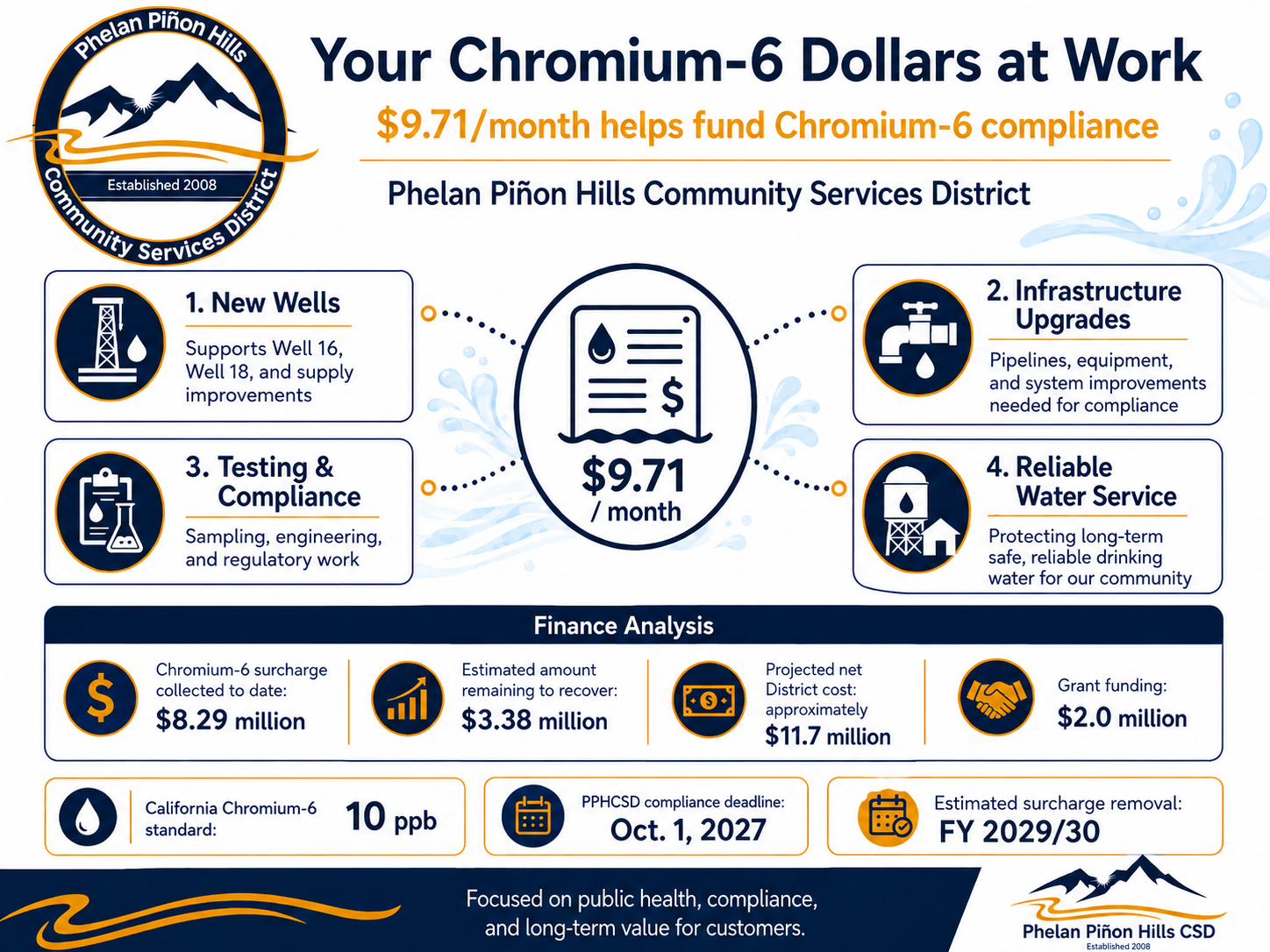
The $9.71 monthly Chromium-6 surcharge is a separate cost-recovery charge used to pay for the District's Chromium-6 mitigation program. It is charged per account rather than based on the amount of water a customer uses. The District's 2023 Water Rate Study calculated the charge using an annual Chromium-6 revenue requirement of approximately $839,000, divided among approximately 86,400 annual customer bills (approximately 12 bills per household with approximately 7,200 District households at that time), resulting in the current $9.71 monthly charge.
When Will the Chromium-6 Surcharge Come Off My Bill?
Based on the District's current financial projections, the $9.71 monthly Chromium-6 surcharge is expected to be removed from customer bills during Fiscal Year 2029/2030.
The surcharge was established to recover the District's costs associated with meeting California's Chromium-6 drinking water requirements. District staff regularly review project expenditures, surcharge revenues, grant funding, and the remaining amount to be recovered.
As the Chromium-6 compliance projects are completed and final costs are known, the District will continue to monitor the balance and keep customers informed. Based on the most recent financial analysis, the District currently anticipates that the surcharge can be discontinued in FY 2029/2030.
1. What is Hexavalent Chromium?
Hexavalent Chromium, also called Chromium-6 or Cr6, within the District is a form of chromium from erosion of natural deposits occurring in the groundwater aquifer.
2. What is the State of California's maximum contaminant level (MCL) for Cr6?
California's State Water Resource Control Board's (SWRCB) current MCL for Hexavalent Chromium is 10 parts per billion (ppb), equilvalent to 10 micrograms per liter (µg/L).
3. Is our water currently safe to drink?
Yes, the Federal Environmental Protection Agency (EPA) still considers anything below 100 parts per billion (ppb) in your drinking water to be acceptable for consumption. The State of California SWRCB recently changed their requirements for Hexavalent Chromium levels in drinking water from 50 ppb to 10 ppb. District wells Cr6 detection range from 0-25 ppb.
4. If a well is above 10ppb, why is it still operating?
The MCL for Cr6 has recently been reduced to 10 ppb from the higher MCL of 50 ppb. District wells Cr6 detection range from 0-25 ppb. The SWRCB allows for the District's wells to continue to operate while the District is working towards compliance.
5. When must the District comply with the updated MCL?
California established different compliance dates based primarily on the number of service connections. Based on the service connections for the District, the District's compliance date is October 2027.
6. How many District wells have elevated Cr6 levels?
The District has 3 wells whose levels are over the MCL levels. However, two of the three wells are hardly ever used and none of the wells have exceeded 25 ppb which is well under the national level of 50 ppb.
7. Where does Cr6 come from? Is it contamination?
Cr6 within the District's wells occurs naturally from erosion of natural deposits occurring in the groundwater aquifer. Elevate Cr6 does not automatically mean there was an industrial spill or contamination event.
8. Can Cr6 be removed from drinking water?
Yes. Treatment technologies are available, including processes that reduce Cr6 to trivalent chromium followed by removal, as well as certain ion-exchange and other treatment approaches.
9. Why not just shut down wells with Cr6 above 10 ppb?
Shutting down wells can affect water supply, storage, system pressure, fire-flow capability, and the operation of the overall distribution system. The District must balance water-supply reliability with regulatory compliance.
10. Can water from a higher Cr6 well be blended with water from another well?
Potentially, depending on the system configuration and regulatory requirements. However, blending must be carefully evaluated and cannot simply be assumed to be an acceptable compliance strategy. The District investigated constructing a system for blending water from the wells acquired from the dairy property with the District's wells containing Cr6. It was determined that the cost was much higher than the current approach of constructing new wells, well-profiling and rehabilitation along with additional upgrades that have been completed.
11. How is Cr6 compliance being funded?
The Chromium-6 Project is currently being funded through a surcharge of $9.71 per month per connection to the water system.
12. Why drill new wells instead of treating the existing wells?
In the District's case, drilling a new groundwater source with lower Cr6 is more economical and operationally practical than installing treatment at multiple aging wells. Treatment facilities often have a higher ongoing operational and maintenance cost than operation and maintenance of a new well.
13. How do you know a new well will have a lower Cr6?
No one knows with certainty that a new well will be Chromium-6 free until the aquifer is tested and sampled. The District has drilled 3 new wells with the first going into service in early 2024 and the additional 2 wells currently under construction with planned service beginning mid-2027. Geophysical logging, spinner surveys, depth-specific sampling, and pumping tests have determined that Cr6 within these new wells is below the MCL.
14. Why perform depth-specific water-quality sampling or a spinner survey?
A spinner survey identifies where water is entering the well, while depth-specific sampling helps determine the water quality associated with the different water-bearing zones. Together, they can help determine whether certain zones are contributing disproportionately to Cr6 and whether modifying the well construction could improve finished water quality.
15. Can certain sections of a well be sealed off to reduce Cr6?
Potentially. If testing determines that a particular aquifer zone contributes higher Cr6 concentrations, engineering modifications may be considered. The downfall with sealing off a specific zone is potentially reducing the well's production capacity. The District has completed well profiling and zone sampling on several wells. Lower production pumps will be installed in wells along with a packer to seal off upper zones.
16. How frequently is the water tested for Cr6?
Sampling frequency depends on regulatory requirements, compliance status, and the specific source. The District wells which exceed the new MCL are currently sampled quarterly. The sampling schedule for the District's reaming wells are sampled every 36 months.
17. Is Cr6 the same as total chromium?
No. Total chromium measures chromium collectively, while Chromium-6 specifically measures chromium in the +6 oxidation state.
18. Will boiling the water remove Cr6?
No. Boiling is not an effective method for removing Cr6 and can concentrate dissolved minerals as water evaporates.
19. What is the District doing to comply?
The District has been working towards compliance with several projects that have been completed and a few currently under construction. The District has profiled and completed depth sampling on several wells. Several wells have been rehabilitated with updated pumping equipment. Servers for SCADA controls have been upgraded to have more reliable control of the system. A new well was drilled, equipped and brought online to the system. Two new wells are being completed.
20. I just found out about this. How are you notifying customers?
The District has proactively been working towards reducing the Cr6 levels with the Chromium-6 Project since 2015 even though the average levels detected for Cr6 in the drinking water have always been well below the 50 ppb which the State of California considered acceptable until the new MCL of 10 ppb.
If you are still concerned with the health effects of Hexavalent Chromium at the level found in your drinking water, the SWRCB recommends that you check with your health provider.